culture
From Dust to Light: How Freemasonry Took Root in El Paso
H. Caleb Lara · 19 de abril de 2026
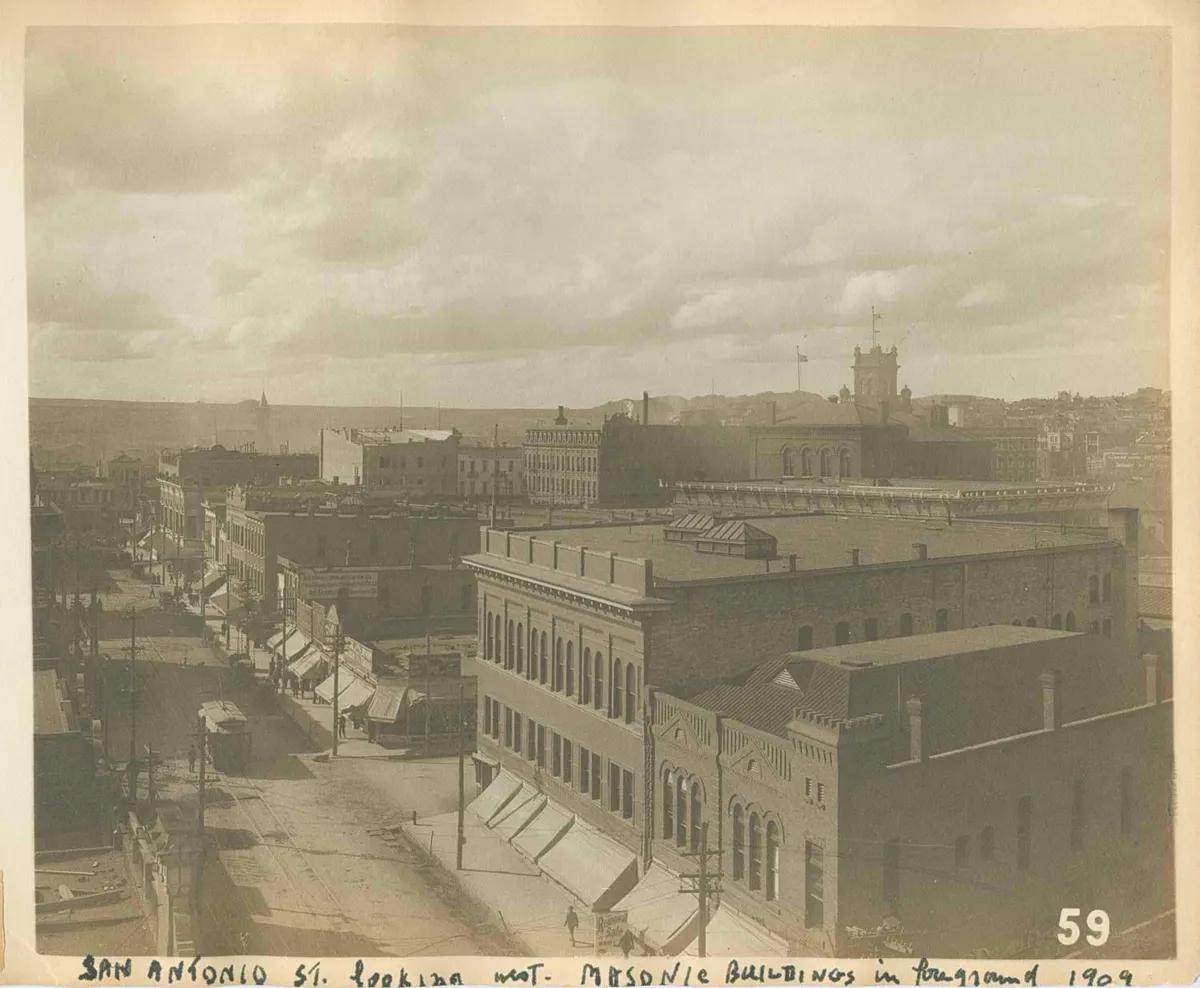
When seven weary horsemen crested the edge of the Rio Grande valley in 1852, there was little more than dust, mesquite and danger. The men, led by Joel L. Ankrim, carried a Masonic charter through six hundred miles of wilderness from San Antonio, determined to plant a lodge where none yet stood. Their journey, part pilgrimage and part ordeal, would give birth two years later to El Paso Lodge No. 130, the first Masonic lodge in far-west Texas.
According to early records, the charter they secured on Jan. 21, 1854, was sponsored by Alamo Lodge No. 44 in San Antonio. It made El Paso a recognized node in a network of frontier brotherhood stretching from the Gulf Coast to New Mexico. To those first seven Masons, the parchment they carried was more than paperwork it was, as later generations described, “a talisman transforming wilderness into sacred ground.”
A City Built on Brotherhood
Freemasonry reached El Paso long before the railroad or the streetcar, and for decades the lodge hall doubled as a civic forum. Minutes from the 1860s show Masons organizing relief for families displaced by Apache raids and Civil War shortages. When Brother Nathan Webb died in 1866, his widow deeded her backyard as a burial site for the brethren. “Keep this ground for your dead,” she told them. That small act became the seed of the Masonic Cemetery that still anchors Concordia to this day a reminder that even in death, fellowship bound the community.
By the 1870s El Paso’s square-and-compass men had woven themselves into nearly every frontier institution. Judge Gaylord J. Clarke, a Mason and co-founder of St. Clement’s Episcopal Mission, lost his life trying to break up a gunfight outside Dowell’s Saloon. His remains; and those of other early brothers, were later found under the foundation of The Popular Dry Goods Store, a macabre metaphor for the way the city’s prosperity was literally built atop the sacrifices of its peacemakers.
Order from the Border’s Chaos
Few figures embodied the contradictions of the borderlands like Charles Howard, another Mason who became ensnared in the 1877 Salt War. His attempt to privatize communal salt beds near San Elizario ignited an uprising that ended with his execution by firing squad. Howard’s story, say local historians, became a cautionary tale within lodge lore, a reminder that when profit overrides principle, even the initiated can lose their moral compass.
Amid such turbulence, Masons kept building. Albert Pike, the towering philosopher of American Freemasonry, personally visited El Paso in 1883 to institute Scottish Rite bodies. The population was too transient to sustain them, and Pike advised his followers to preserve their ritual furniture “until the soil was ready.” Two decades later, that patience paid off: the Scottish Rite returned permanently, culminating in the construction of one of the Southwest’s grandest Masonic cathedrals.
Builders, Healers and Revolutionaries
As the nineteenth century turned, Masons stood at the crossroads of commerce and revolution. Dr. August Justice, a Civil War surgeon living on Magoffin Avenue, quietly converted his home into a command post for Francisco Madero’s revolutionary forces. Across the river, Dr. Ira J. Bush, another brother, treated the wounded of the insurgent army. Their dual lives as healers and conspirators embodied what scholars call the “invisible college” tradition: change accomplished through quiet, disciplined service rather than public acclaim.
Nearby merchants carried the same ethos into business. Solomon C. Schutz, El Paso’s mayor and Worshipful Master of Lodge 130, helped his nephew Ernst Kohlberg establish the Southwest’s first cigar-manufacturing empire. Their fellow Mason Adolph Schwartz, founder of The Popular Dry Goods, risked ruin during the Mexican Revolution by extending credit to Pancho Villa’s soldiers. When peace returned, Villa’s men repaid him, literally, with a railcar full of silver bullion. That “silver redemption,” still retold in lodge anecdotes, captured the era’s blend of peril and principle: trust across borders repaid with honor.
The Visible Temple
By 1912, El Paso Masonry had outgrown adobe halls. The brothers commissioned Trost & Trost, the visionary architectural firm behind many downtown landmarks, to design a five-story steel-frame Masonic Temple at Fourth and Mesa. On Thanksgiving Day that year, lodges from across Texas and New Mexico paraded in full regalia to lay its cornerstone, a public declaration that the frontier town had matured into a city of order and aspiration. The building’s vertical design embodied Masonic symbolism: the ground floor open to the public, the middle floors for fellowship, the upper chambers for philosophical study, a literal ascent from earth to light.
The temple stood as a civic beacon for more than half a century. When it was demolished in 1969, much of its handcrafted furniture was distributed to lodges across the state. Today, visitors to El Paso Lodge No. 130 still sit in chairs that may have supported Mayor Schutz or merchant Schwartz more than a century ago.
Modern Reflections from the Craft
For Brother John Wood, who joined the fraternity in 1974 and served as secretary of Lodge 130 for fifteen years, that continuity is tangible. “We’re sitting on some of the original chairs from the late 1800s,” he said in a recent interview. “We could be sitting where Solomon Schutz once sat.” Wood has spent decades preserving the lodge’s archives, unearthing stories of members who served in the OSS and later the CIA, or who repaired Air America planes during the Vietnam War. The lineage of service, he says, runs unbroken from frontier lawmen to Cold War codebreakers.
He notes that the first five mayors, the first five postmasters, and the first federal judge of El Paso were all Masons. Even the city’s early rabbis at Temple Mount Sinai held membership, illustrating how Freemasonry bridged faiths and professions in a pluralistic border town. “Our history is tied to every cornerstone of El Paso,” Wood said. “Doctors, merchants, soldiers, politicians, they all met here as equals.”
Enduring Lessons
From Ankrim’s seven riders to Trost’s five-story temple, the story of El Paso Masonry mirrors the city itself: a passage from isolation to interconnection, from desert hardship to civic light. Its teachings, discipline, moral law, and the belief that order must be won from chaos, shaped generations of builders, judges, and merchants who turned a dusty frontier into a thriving metropolis.
Today, amid the hum of traffic and digital noise, the old lodge on Montana Avenue still opens its doors each month. The ritual words have changed little since 1854. Within those walls, young initiates rise to speak, sometimes nervously, sometimes in accented English, and discover, as countless brothers before them did, that the true work of building never ends.