culture
Flags of the Texas Revolution, Coahuila y Tejas 1821 - 1836
By Bernie Sargent, · August 6, 2026
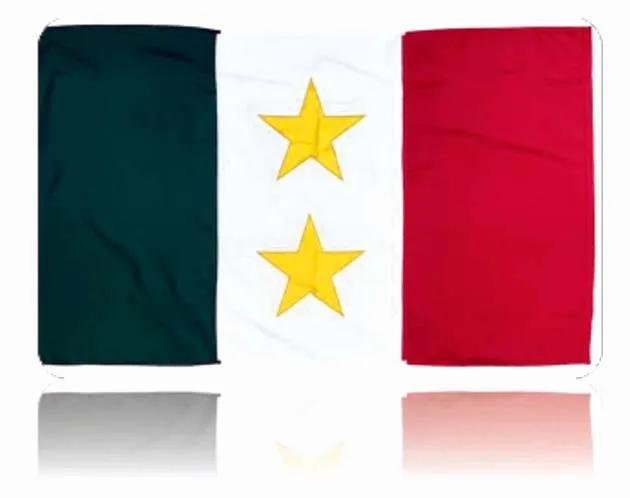
Coahuila y Tejas — officially the Estado Libre y Soberano de Coahuila y Tejas — was one of the states stitched together by Mexico’s 1824 Constitution: think of it as a political shotgun wedding between old-guard Coahuila, with its ranchos and colonial towns, and frontier Texas, a wide-open place full of empresarios, stray cows, and folks who’d rather settle than sit in a Saltillo courtroom. That mismatch made for a decade of polite cooperation, occasional shouting matches, and one flag with two stars trying to keep the peace.
Geography and the awkward marriage The new state combined the settled interior of Coahuila — Saltillo and Monclova, towns that had been running things since Spain — with the sparsely populated stretch of Texas centered on San Antonio de Béxar and scattered colonies. Administratively it was split into departments: Béxar for Texas, Monclova and Río Grande Saltillo for Coahuila. On paper it was united; in practice it was like asking two neighbors who speak different languages to share a mailbox.
Capitals and capital tiffs Saltillo got the nod as capital early on (1822–1825) after Miguel Ramos Arizpe pushed for it, but Monclova — the older colonial seat since 1689 — reclaimed its pride. That back-and-forth set off political squabbles so spicy the Saltillo–Monclova rivalry simmered for years; by the late 1830s things nearly boiled over, and Santa Anna’s political persuasion finally persuaded Monclova to let Saltillo keep the reins. Meanwhile, Texans felt about as represented as a cow at a poultry convention.
Why Texans were squeezed Texas had far fewer people than Coahuila, so its legislative clout in Saltillo was modest. Delegates like Stephen F. Austin and Ramón Músquiz pushed for more say, local municipalities, and allowance for some English-language practices, but the imbalance stuck. Miguel Ramos Arizpe persuaded Bexar’s ayuntamiento to accept the merger by warning that federal territories would lose ownership of public lands to Mexico City — statehood let them keep the land — and land talk tends to hush most arguments faster than a sheriff’s whistle.
The empresario experiment and cultural sparks Mexico encouraged settlement to secure the frontier via the 1824 General Colonization Law. Empresarios like Stephen F. Austin and Green DeWitt brought families, laid out colonies (Gonzales, anyone?), and boosted population. Settlers were supposed to convert to Catholicism and obey Mexican law on paper; in practice frontier life meant few priests and plenty of improvisation. The empresario system did its job — it filled the place up — but also brought in Anglo customs and loyalties that rubbed Mexican authorities the wrong way and made future troubles more likely.
Legal mismatch and local reforms Coahuila y Tejas adopted a state constitution in 1827 and a unicameral legislature, and Texas was later divided into departments like Béxar, Brazos, and Nacogdoches to improve administration. Still, civil law, Mexican municipal forms, and a distant capital never meshed well with settlers used to common-law habits and local control. Reforms eased things a bit (more municipalities, limited English use, some jury trial provisions), but the fundamental demographic and cultural imbalance remained.
The national storm and the breakup Mexico wavered between federalism and centralism after independence from Spain in 1821. In 1835 the centralist “Constitutional Bases” scrapped the federal system and turned states into departments; that blow to local power pushed many regions to rebel. Rival governments in Saltillo and Monclova dissolved legislatures, and arrests of governors followed. Texans, loyal to the 1824 Constitution, took offense and in late 1835 rose in revolt; by March 1836 they’d declared the Republic of Texas. Coahuila’s response fractured too — parts joined the short-lived Republic of the Rio Grande, and other provinces like Yucatán and Tamaulipas also rebelled over centralism.
Administrative legacy Though short-lived, Coahuila y Tejas left a mark: land-distribution methods, municipal courts, and early political careers of Texas Revolution leaders grew from this era. The experience of elections, constitutional debate, and civil-law governance shaped the region’s institutions even after the breakup.
And the flag? Two stars and a bit of symbolism One charming bit of frontier heraldry: a tri-colored flag with two stars — said to represent Coahuila and Tejas together — is reported among the banners flown at the Alamo. The two stars replaced the eagle on that version of the flag to show the union between the two parts of the state; contemporaries noted it with a mix of pride and, later, irony — kind of like a couple putting matching “His” and “Hers” mugs on the kitchen shelf while planning separate exits. Col. Juan Almonte recorded seeing a two-star tricolor at the siege of the Alamo, cementing the image in the legend.
Bottom line, with a wink Coahuila y Tejas was an uneasy but practical pairing: Coahuila’s settled governance plus Texas’s sprawling frontier energy. It worked about as smoothly as fitting a longhorn into a city bus — inventive, occasionally effective, and destined to make people step out and say, “Now how’d we end up in this pickle?” The experiment taught both regions’ lessons in law, land, and politics — and left behind a little two-star flag that, for a time, said they were hanging together, whether or not everyone minded the arrangement. By the mid-1830s the experiment had ended, leaving behind a Texas that would turn into an independent republic and a Coahuila that would have to find new political arrangements — and both regions a shared history as partners who never quite learned to dance in step.
Sources: Texapedia, The Portal to Texas History, TSHA, History Atlas, Sons of DeWitt Colony Texas